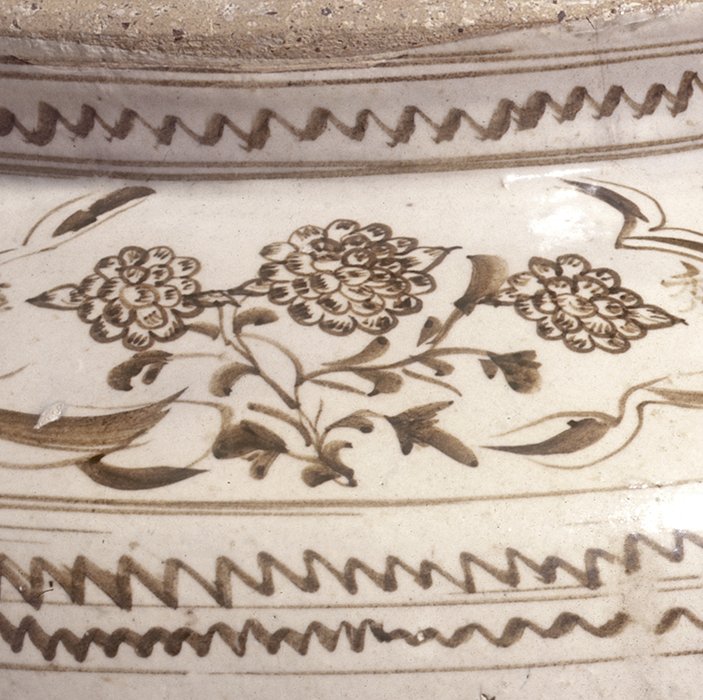
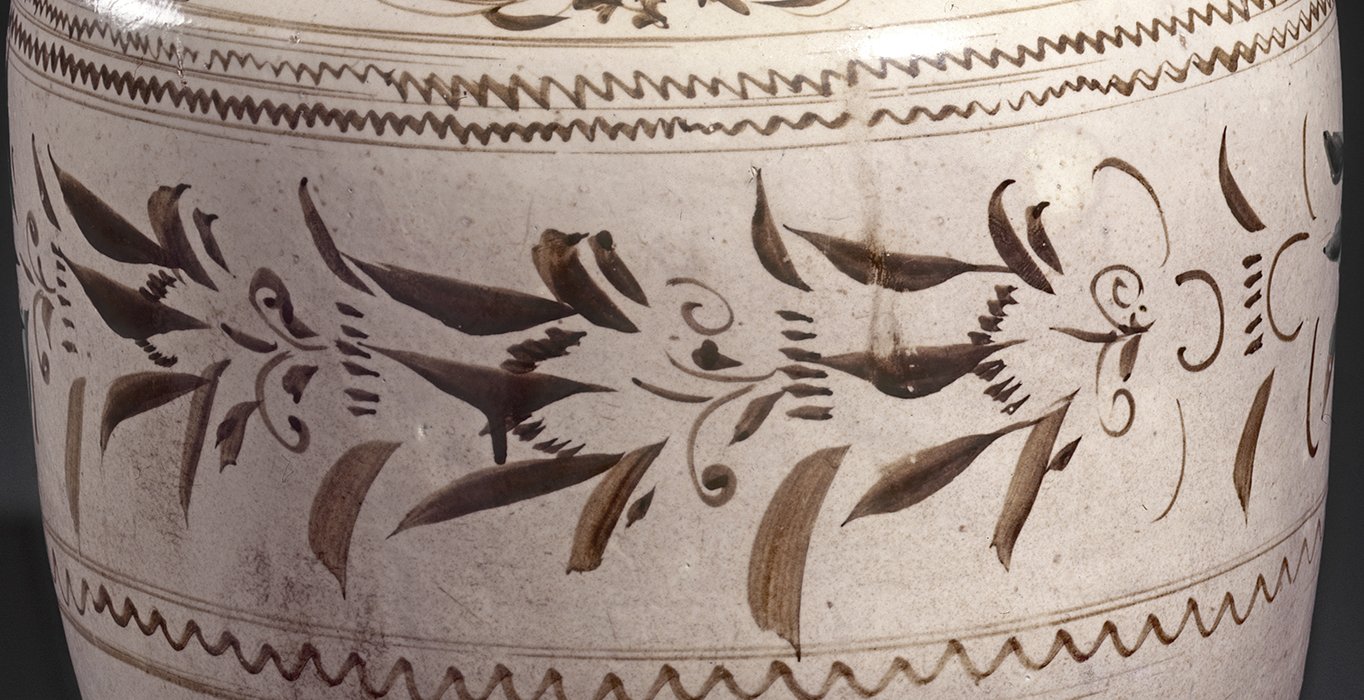
The monumental vessel is supported on a wide foot surrounding a recessed base, the walls of the hefty ovoid body rising to the steeply slanted shoulder. A high straight neck surrounds the wide mouth, the generous opening giving easy access to the vast interior, making retrieval of its liquid contents an easy task. The coarse clay body was coated with white slip providing a light smooth ground for the brown-slip painted designs that occupy the main body zone, comprised of a leafy garland around the vessel oriented in a lateral direction, bordered by narrow wavy bands. Four lobed quatrefoil panels arranged equidistantly on the shoulder frame bird and flower scenes. Calligraphic inscriptions are written within each panel and also in the spaces between the panels. The four-character phrases written vertically between the panels can be translated “lovely flavor, fragrant and sweet,” “refined air, so restful,” “glorious beyond compare,” and “like gold and jade filling the hall.” The two characters within each of the arches can be read “pure spirit,” “restful,” “refined air,” and “glorious,” restating the messages conveyed by the longer phrases.
Ming-dynasty folk seem to have liked their wine and this type of vessel, which survives in good number, must have been intended for use by their wine vendors. The characters incorporated into the decorative schemes of the vessels convey messages which invariably relate to the glories and wonders of wine and often dates of production are included. An inscription on a jar in the Royal Ontario Museum seems in fact to be a perfect sales pitch: “Fine rice selected in spring for this jar of fragrant sweet wine of high quality” (fig. 1).
The compositions of the painted decoration are not only distinctive but rather innovative with the leaf garlands or motifs in the main body zones directed sideways as they circle the hefty bodies of the vessels. It is as if the décor is being swept sideways by a breeze, an unusual orientation whose source is not entirely clear. The last half of the 16th century was the heyday of such jars when high quality and even a bit of sophistication are evident in comparison to the wine vessels produced a century or so later. The decoration on those later vessels are normally sparer in motif and even more spontaneous and rough in painting style.
These slip-decorated stonewares are part of the extensive Cizhou family emanating from kilns in several provinces. Shandong, which became a major wine-producing area in recent times and was known for its rice-wine during the Ming period, was also a center of Cizhou ware production and could well have been a source for such wares.
…

Fig. 1: Cizhou ware painted wine jar, Ming dynasty, dated to 1571, Royal Ontario Museum, Toronto, after Yutaka Mino & Katherine R. Tsiang, Freedom of Clay and Brush through Seven Centuries in Northern China: Tz’u-chou Type Wares, 960-1600 A.D., Indianapolis, 1981, p. 195.
Details: